
Network analysis: how links between people, companies, websites and accounts are mapped and read to uncover hidden structures
How network analysis is done in OSINT: nodes and links, degree, betweenness, communities and bipartite networks, technique from the question to the graph, sources such as registers, investigative databases, social media and web infrastructure, tools such as Gephi, Maltego, Neo4j and NetworkX, the case of the “Portal Kombat” network, an example in Python, limits, documentation and frequently asked questions.

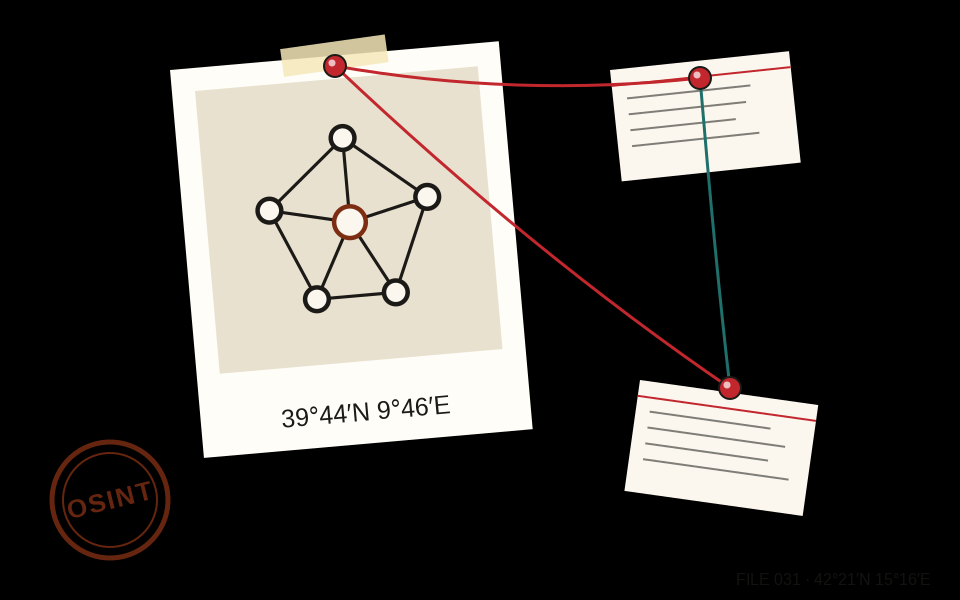
Many investigations look not for an isolated fact but for a structure: who controls a chain of companies, who coordinates a campaign of accounts, which websites belong to the same operator, who acts as a bridge between two groups. Network analysis represents these relationships as a graph: the nodes are people, companies, addresses, phone numbers, websites or accounts; the links are directorships, ownership, payments, messages, forwards or shared infrastructure.
The value lies not in the drawing but in what the drawing makes it possible to see and measure: the node that holds everything together, the group that moves in a coordinated way, the link nobody had noticed. And the risk is the mirror image: a dense graph looks like proof even when the links are weak, homonymous or coincidental.
The elements of a network
- Nodes
- People, companies, addresses, phone numbers, websites, accounts, wallets.
- Links
- Directorships, shareholdings, payments, messages, forwards, shared servers or codes.
- Attributes
- Source, date, reliability and weight of each node and link.
- Direction
- Who controls whom, who pays whom, who forwards whose content.
- Weight
- Frequency of contacts, amounts, number of shared items.
- Time
- When a link begins and when it ends.
Network analysis uses data from social media OSINT, Telegram, whois and domains and company registers. The basic entries are link analysis, pivot and coordinated inauthentic behaviour.
The pages of this topic
Network analysis: how it works
How network analysis works: degree, betweenness, closeness, influence, communities and bipartite networks, with examples, and why every link is worth as much as its source.
Network analysis: technique
The technique of network analysis: defining the question, choosing nodes and links, collecting and normalising data, building the graph, calculating measures, visualising, interpreting with alternative hypotheses, following time, documenting.
Network analysis: sources
Sources for network analysis: company registers, investigative databases such as Offshore Leaks, social media and messaging, web infrastructure, procurement and open data, sanctions lists.
Network analysis: tools
Tools for network analysis: Gephi, Maltego, Neo4j and Linkurious, NetworkX and igraph, i2 Analyst’s Notebook, spreadsheets and capture tools.
Network analysis: examples
A real case and a guided example: the “Portal Kombat” network of websites uncovered by VIGINUM through shared infrastructure and content, and a small network of people and companies measured in Python to find the only bridge between two groups.
Network analysis: limits
The limits of network analysis: incomplete data, homonyms, links of different kinds, shared infrastructure, the persuasive effect of graphs, outdated links, privacy, fragile measures.
Network analysis: how to document
How to document a network analysis: a table of links with source and date, captures, versions of data and tools, parameters of the measures, charts with legends, alternative hypotheses, reproducibility.
Network analysis: frequently asked questions
Short answers to the most common questions about network analysis in OSINT.
More topics in this section
Social media OSINT
How OSINT is done on social networks: profiles, posts, comments, photos and contact networks, numeric identifiers and creation dates, advanced search and archives, changes to platforms and researcher interfaces, cover profiles and legal limits, tools, an example of a fake account, limits, documentation and frequently asked questions.
9 pages
Usernames
How usernames are used in OSINT investigations: why people reuse them, searching hundreds of sites with Sherlock, Maigret and WhatsMyName, variants and name changes, numeric IDs, account information shown by platforms, archives, the Silk Road case, false positives and namesakes, legal limits, documentation and frequently asked questions.
9 pages
Telegram
How to do OSINT on Telegram: channels, groups, bots and secret chats, the web preview of public channels, IDs and message numbers, forwards and the origin of content, exporting with Telegram Desktop, tools such as Telepathy, TGStat and Telethon, cooperation with authorities after Durov’s arrest, an example of a recycled video, legal limits, documentation and frequently asked questions.
9 pages